Navigating the world of sales tax can feel like decoding a complex puzzle—especially when geography comes into play. Enter destination based sales tax, a system that’s reshaping how businesses collect and remit taxes across state lines. Let’s break it down in plain terms.
What Is Destination Based Sales Tax?

The concept of destination based sales tax is foundational to understanding modern tax compliance, especially in the era of e-commerce. Unlike older models, this system prioritizes where the buyer receives the product or service, not where the seller is located. This shift has profound implications for businesses operating across multiple jurisdictions.
Definition and Core Principle
Destination based sales tax means that the tax rate and rules applied to a sale are determined by the location where the product is delivered or where the service is consumed. In other words, if a customer in Texas buys a laptop from a company based in Oregon, the tax is calculated based on Texas rates and regulations.
This model stands in contrast to the origin-based system, where taxes are based on the seller’s location. The destination model aims to create a fairer tax environment, ensuring that local governments receive tax revenue from economic activity happening within their borders.
- Tax is applied based on buyer’s shipping address
- Local tax jurisdictions (city, county, state) all contribute to the final rate
- Common in states with complex tax structures like California and New York
According to the Tax Foundation, over 30 U.S. states use a destination-based approach for most sales, making it the dominant method in the country.
How It Differs From Origin-Based Sales Tax
The key difference lies in jurisdictional responsibility. In an origin-based system, businesses only need to comply with the tax laws of their own location. This simplifies compliance for local vendors but can lead to revenue loss for other areas where goods are consumed.
For example, if a company in Kansas sells online to a customer in Colorado under an origin-based model, the sale would be taxed at Kansas rates—even though the economic benefit (the use of the product) occurs in Colorado. This discrepancy is precisely what destination based sales tax aims to correct.
“The destination principle ensures that tax follows consumption, not production, aligning revenue collection with where economic activity actually takes place.” — Tax Policy Experts, Brookings Institution
States like Texas and Washington operate under strict destination rules, requiring sellers to collect local taxes down to the ZIP code level. This granular approach increases accuracy but also complexity for remote sellers.
Why Destination Based Sales Tax Matters Today
The rise of e-commerce has made destination based sales tax more relevant than ever. With consumers buying from across the country, states are keen to protect their tax bases. This system ensures they aren’t left behind when residents purchase from out-of-state vendors.
Impact on E-Commerce Growth
As online shopping continues to surge—reaching over $1 trillion in U.S. sales in 2023—states have responded by tightening tax enforcement. The destination based sales tax model allows them to capture revenue from digital transactions that previously slipped through the cracks.
Platforms like Amazon, Etsy, and Shopify now automatically calculate and collect sales tax based on the buyer’s location, thanks to integrated tax software such as Avalara and TaxJar. These tools rely heavily on destination-based logic to ensure compliance.
For small businesses selling online, this means greater responsibility. A store in Maine selling handmade candles must now collect different tax rates for customers in Florida, Illinois, and Nevada—each governed by their own destination rules.
- Over 90% of online retailers now collect sales tax at checkout
- Automated tax engines reduce compliance burden
- Consumers see transparent pricing with tax included
The shift benefits both governments and consumers by creating a level playing field between local brick-and-mortar stores and national e-commerce giants.
State Revenue Protection and Fair Competition
One of the strongest arguments for destination based sales tax is fairness. Before the 2018 Supreme Court decision in South Dakota v. Wayfair, Inc., remote sellers could often avoid collecting sales tax, giving them an unfair price advantage over local businesses that had to charge tax.
After Wayfair, states gained the authority to require out-of-state sellers to collect tax based on the buyer’s location—essentially mandating destination based sales tax compliance for remote sales. This ruling empowered states to reclaim billions in lost revenue.
According to a National Taxpayers Union Foundation report, states collected over $20 billion in additional sales tax revenue in 2022 alone due to post-Wayfair enforcement of destination-based rules.
“Without destination-based collection, local retailers suffer while out-of-state sellers gain an artificial pricing edge.” — State Revenue Commissioner, Colorado Department of Revenue
This model levels the playing field, ensuring that all sellers—regardless of location—contribute fairly to the communities where their customers live.
How Destination Based Sales Tax Works in Practice
Understanding the mechanics of destination based sales tax is crucial for any business involved in interstate commerce. It’s not just about applying a single rate—it involves navigating layered tax jurisdictions and constantly updated rules.
Tax Jurisdiction Layers: State, County, City, and Special Districts
In the U.S., sales tax isn’t just a state-level affair. Under the destination based sales tax model, the total tax rate is often a composite of several overlapping jurisdictions:
- State tax: Set by the state legislature (e.g., 6% in California)
- County tax: Additional levy imposed by counties (e.g., 0.25% in Los Angeles County)
- City tax: Municipalities may add their own rate (e.g., 1% in San Diego)
- Special districts: Transportation, public safety, or tourism districts may impose extra fees
For example, a purchase in Chicago, Illinois, might be subject to:
- 6.25% state tax
- 1.75% county tax (Cook County)
- 1.25% city tax
- 1.0% special district tax
- Total: 10.25% combined rate
This complexity means that two addresses within the same city can have different tax rates. Businesses must use precise geolocation data or address validation tools to apply the correct rate.
The Streamlined Sales Tax Governing Board (SSTGB) was created to help simplify this patchwork. Participating states agree to standardize tax bases and administration, making it easier for businesses to comply with destination based sales tax rules across multiple states.
Real-Time Tax Calculation Tools and Software
No business can manually track thousands of tax jurisdictions. That’s where automation comes in. Modern tax compliance platforms like Avalara, TaxJar, and Vertex provide real-time tax calculation based on destination.
These systems integrate with e-commerce platforms (Shopify, WooCommerce, BigCommerce) and accounting software (QuickBooks, Xero) to automatically:
- Detect customer location via IP or shipping address
- Apply the correct combined tax rate
- Generate reports for filing
- Update rates as laws change
For instance, if a new city tax goes into effect in Austin, Texas, Avalara’s system will update its database and apply the change automatically—without requiring manual intervention from the seller.
This level of automation has made it feasible for even small businesses to comply with destination based sales tax requirements across multiple states.
States That Use Destination Based Sales Tax
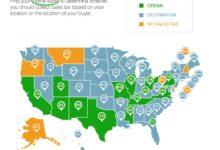
While most U.S. states follow the destination principle, there are notable exceptions. Understanding which states use destination based sales tax—and which don’t—is essential for compliance planning.
List of Destination-Based States
The vast majority of states—38 in total—apply destination based sales tax for most retail transactions. These include:
- California
- Florida
- Georgia
- Illinois
- Michigan
- New York
- Ohio
- Pennsylvania
- Texas
- Washington
In these states, sellers must collect tax based on the buyer’s delivery address. This applies to both in-state and out-of-state sellers who meet economic nexus thresholds (typically $100,000 in sales or 200 transactions annually).
Many of these states also participate in the Streamlined Sales Tax Program, which reduces administrative burdens by standardizing tax rates, definitions, and filing processes.
For example, Kansas requires all remote sellers to collect tax based on the destination, with over 1,000 unique tax jurisdictions to consider. The state provides a certified automated system to help businesses comply.
Origin-Based States and Exceptions
A handful of states still use an origin-based model for certain types of sales. These include:
- Arizona
- Missouri
- Utah
- Virginia
- Alaska (no state tax, but local rates apply)
In Arizona, for example, in-state sellers collect tax based on their business location, not the customer’s. However, out-of-state sellers must still collect based on the destination—creating a hybrid system that can confuse businesses.
Missouri uses origin-based rules for in-state sellers but requires remote sellers to use destination-based collection. This dual approach stems from legislative compromises and highlights the complexity of U.S. tax policy.
Utah is transitioning toward destination-based collection and now requires remote sellers to collect based on the buyer’s location, even though local sellers may still use origin rules in some cases.
“The patchwork of origin and destination rules across states is one of the biggest challenges for national retailers.” — National Retail Federation
Businesses must carefully track not only which states use destination based sales tax, but also how those rules apply to different types of sellers and products.
Economic Nexus and Its Role in Destination Based Sales Tax
The concept of economic nexus is the legal trigger that requires a business to collect destination based sales tax in a state—even if it has no physical presence there. This principle emerged from the landmark Wayfair decision and has transformed tax compliance.
Understanding Economic Nexus After Wayfair
Prior to 2018, the Supreme Court ruled in Quill Corp. v. North Dakota that businesses only had to collect sales tax if they had a physical presence (like a store or warehouse) in a state. This protected remote sellers from complex multi-state tax obligations.
The South Dakota v. Wayfair, Inc. decision overturned Quill, allowing states to require tax collection based on economic activity. South Dakota’s law required out-of-state sellers to collect tax if they had either:
- More than $100,000 in annual sales into the state, OR
- 200 or more separate transactions
This “economic nexus” standard has been adopted by nearly every state with a sales tax. Once a business meets this threshold in a destination state, it must begin collecting destination based sales tax from customers in that state.
For example, a small online bookstore in Maine might not think it owes taxes in Tennessee—until it hits $100,000 in sales to Tennessee residents. At that point, it must register, collect, and remit tax based on each customer’s location within Tennessee.
Threshold Variations Across States
While most states use the $100,000/200-transaction benchmark, some have different thresholds:
- California: $500,000 in sales (as of 2024)
- Colorado: $100,000 sales or 200 transactions
- Mississippi: $250,000 in sales
- North Dakota: $100,000 sales or 200 transactions
- Rhode Island: $100,000 sales or 200 transactions
These variations mean businesses must monitor their sales data by state to avoid non-compliance. Exceeding the threshold—even by a small margin—can trigger retroactive tax liability in some states.
Additionally, some states apply different rules for marketplace facilitators. For instance, in New York, if a seller uses Amazon or eBay, the platform may be responsible for collecting tax, reducing the burden on the individual seller.
The Multistate Tax Commission (MTC) provides a free Economic Nexus Program to help small businesses navigate these rules and register in multiple states with simplified procedures.
Challenges Businesses Face With Destination Based Sales Tax
While destination based sales tax promotes fairness and revenue stability, it also introduces significant operational challenges—especially for small and mid-sized businesses.
Complexity of Multi-Jurisdictional Compliance
With over 12,000 tax jurisdictions in the U.S., complying with destination based sales tax is a logistical nightmare without automation. Each jurisdiction can have its own:
- Tax rates
- Tax holidays
- Exemptions (e.g., clothing, groceries)
- Filing frequencies (monthly, quarterly, annually)
A business selling to customers in 20 states could be responsible for tracking thousands of rate changes each year. For example, Texas updates its tax rates quarterly, and cities like Dallas or Houston may introduce temporary surcharges.
Manual tracking is not only error-prone but also risky. Mistakes can lead to audits, penalties, and back taxes. The American Institute of CPAs estimates that sales tax errors cost small businesses an average of $5,000 per year in fines and corrections.
Moreover, some states require sellers to break down tax collections by jurisdiction on their returns—a process that demands precise record-keeping and reporting tools.
Technology and Automation Needs
To manage destination based sales tax effectively, businesses must invest in technology. Basic accounting software often lacks the geolocation precision needed to apply the correct rate.
Advanced solutions offer:
- Real-time API integration with tax engines
- Address validation to confirm delivery location
- Automatic updates for rate changes and tax laws
- Monthly filing and remittance services
However, these tools come at a cost. Small businesses may pay $50–$200 per month for tax automation, which can be a burden for startups or low-margin operations.
Despite the cost, the alternative—non-compliance—is far riskier. States are increasingly aggressive in auditing remote sellers. In 2023, the Federation of Tax Administrators reported a 40% increase in sales tax audits of online businesses compared to 2020.
“If you’re selling online, you’re not just running a business—you’re running a tax collection agency.” — Tax Compliance Consultant, CPA Firm
Investing in automation isn’t optional; it’s a necessity for survival in the destination based sales tax landscape.
Benefits of Destination Based Sales Tax for Governments and Consumers
Despite the challenges, the destination based sales tax model offers significant advantages for public policy and market fairness.
Increased State and Local Revenue
By capturing tax from out-of-state sales, states have seen a dramatic boost in revenue. This funding supports essential services like education, infrastructure, and public safety.
For example, after implementing destination based sales tax enforcement post-Wayfair, South Dakota reported a 25% increase in sales tax collections within two years. Similarly, Colorado added over $300 million in new revenue annually.
This influx allows states to reduce reliance on property taxes or income taxes, creating a more balanced fiscal structure. It also helps fund local governments that were previously losing revenue to online shopping.
According to the Council of State Governments, destination based sales tax has helped close the “online sales gap,” where digital purchases were historically under-taxed compared to in-store buys.
Promoting Fairness in the Marketplace
One of the most compelling benefits of destination based sales tax is equity. Local retailers have long complained that they were at a disadvantage because they had to charge sales tax while out-of-state online sellers did not.
Now, with destination based rules, both local and remote sellers must collect tax based on the buyer’s location. This levels the playing field and ensures that all businesses contribute to the communities where their customers reside.
Consumers also benefit from greater transparency. With tax included at checkout, there are fewer surprises at the end of the transaction. This builds trust and improves the overall shopping experience.
- Local businesses regain competitive footing
- Online prices reflect true cost including tax
- States can invest in community development
The destination based sales tax model, while complex, ultimately supports a more sustainable and equitable economy.
What is destination based sales tax?
Destination based sales tax is a system where the tax on a sale is determined by the location where the buyer receives the product or service, not where the seller is located. This means businesses must collect tax based on the customer’s shipping address, applying the combined state, county, city, and special district rates of that area.
Which states use destination based sales tax?
Most U.S. states—38 in total—use destination based sales tax for remote and in-state sales. This includes major states like California, Texas, Florida, and New York. A few states like Arizona and Missouri use origin-based rules for in-state sellers, but even they require remote sellers to follow destination rules in many cases.
How does economic nexus relate to destination based sales tax?
Economic nexus is the legal threshold that requires a business to collect destination based sales tax in a state. After the 2018 Wayfair decision, states can require tax collection if a business exceeds a certain sales volume (e.g., $100,000 in sales or 200 transactions) into that state, regardless of physical presence.
Do I need software to handle destination based sales tax?
Yes, for most businesses, tax automation software is essential. With over 12,000 tax jurisdictions in the U.S. and frequent rate changes, manual tracking is impractical. Tools like Avalara, TaxJar, and Vertex integrate with e-commerce platforms to automatically calculate, collect, and file taxes based on the buyer’s location.
What happens if I don’t comply with destination based sales tax rules?
Non-compliance can lead to audits, penalties, interest on unpaid taxes, and even legal action. States are actively pursuing unregistered sellers, especially in the post-Wayfair era. It’s crucial to monitor your sales by state and register in any state where you meet the economic nexus threshold.
Destination based sales tax is no longer a niche concept—it’s the new normal in U.S. tax policy. Driven by e-commerce growth and the landmark Wayfair decision, this model ensures that tax is collected where consumption occurs, promoting fairness and boosting state revenues. While compliance is complex, especially with thousands of jurisdictions and varying thresholds, automation tools make it manageable. For businesses, understanding and adapting to destination based sales tax isn’t just about avoiding penalties—it’s about thriving in a transparent, equitable marketplace. As digital commerce continues to evolve, so too will the systems that support it, making tax compliance an integral part of every online transaction.
Recommended for you 👇
Further Reading:
